
Hollywood Bathroom Remodeling Hollywood and nearby cities
Why your bathroom lighting feels wrong and how to fix it
Shadows under the eyes, glare off the tile, a shower you cannot see into. Poor bathroom lighting has clear causes. This page explains them and shows how a remodel plans light in layers that suit the room.
 Hollywood Bathroom Remodeling
Warm design. Clear planning.
Bathroom problem
What bad bathroom light looks like in daily life
People notice bad lighting through small, repeated annoyances. You shave or apply makeup and your face looks gray on one side. You step into the shower and cannot tell if the soap bar is on the floor. You walk in at night and the single overhead bulb is so harsh that you are wide awake for an hour afterward.
These are not matters of taste. They are signs that light is coming from the wrong direction, at the wrong strength, or in a single layer. A bathroom asks more of its lighting than most rooms, because it combines close detail work at the mirror, wet surfaces that bounce glare, and late night visits where a gentle glow matters.
The good news is that the pattern is predictable. When you can name the symptom, you can usually trace it to a specific cause, and a remodeler can plan around it. The first step is to observe your own room at different times of day instead of only when you are in a hurry.
Try a simple experiment. Stand at the mirror in the morning with the lights on and take a photograph of your face with your phone, then do it again in the evening. Compare the two. Then stand in the shower doorway and photograph the stall. Those pictures show the shadows and dark zones more honestly than memory does, and they give a remodeler something concrete to discuss when you describe what bothers you.
The single ceiling fixture problem
Many older bathrooms have one fixture in the middle of the ceiling and a bar of bulbs over the mirror. A lone ceiling light shines down onto the top of your head. That creates shadows under the brows, nose and chin, which is the exact opposite of what you want at a mirror. Faces look tired and details are hard to see.
A fixture over the mirror helps, but if it sits high and throws light downward it still produces shadows, and if it sits low it can reflect glare in the glass. Placement relative to eye height matters more than how bright the bulbs are. Simply adding stronger bulbs to a poorly placed fixture usually makes the glare worse without fixing the shadows.
Another common cause is a fixture that was chosen for looks without thinking about the bulb inside. A decorative glass shade can swallow most of the light, leaving the room dim no matter how many fixtures there are. Look at the light that actually reaches the mirror and the shower, not just at the fixture itself.
Shadows at the mirror and how to even them out
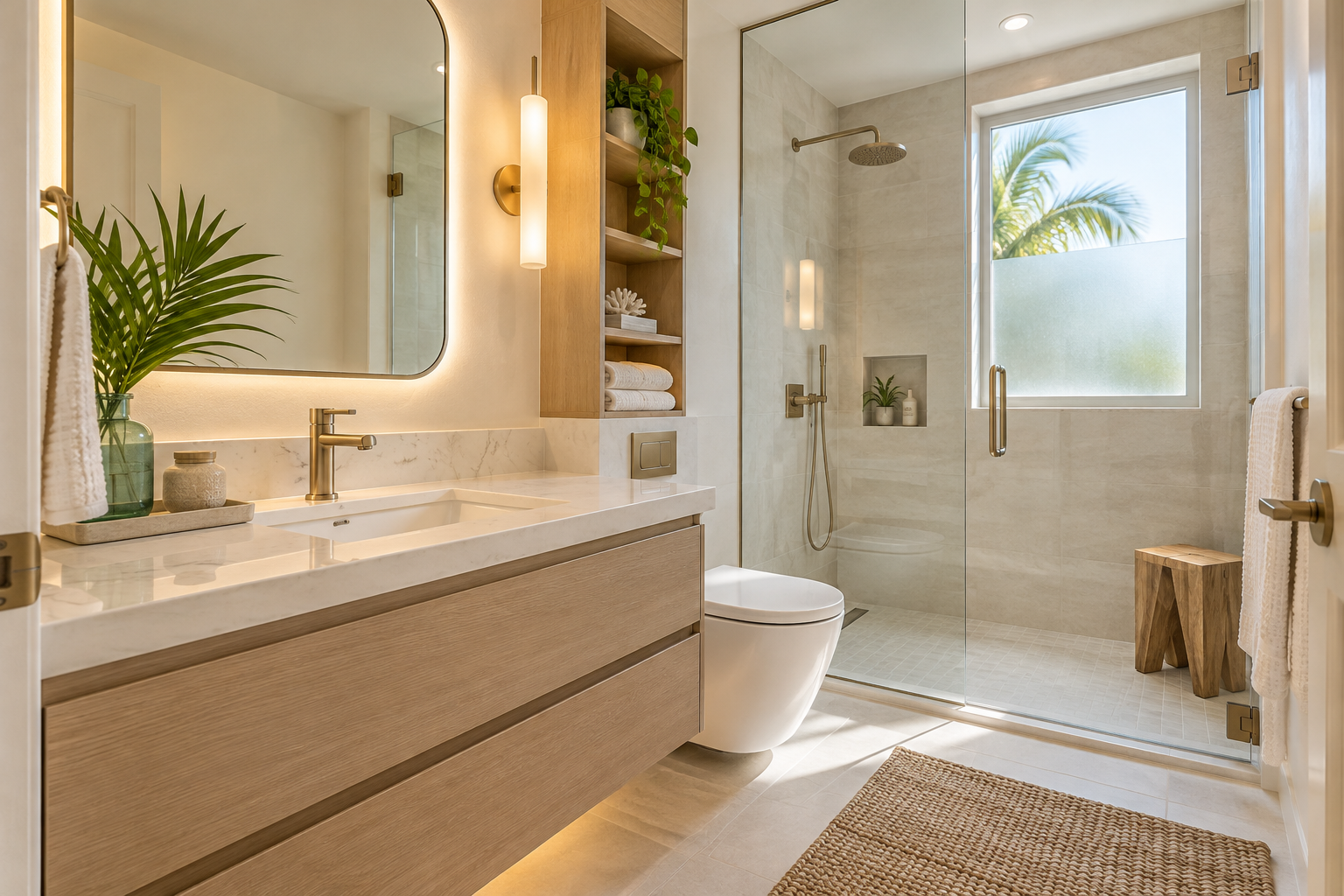
The cleanest light at a mirror comes from both sides at about face height, or from a long fixture above and beside the glass that spreads evenly. Light that comes from the sides fills in shadows from both directions. That is why many designers place vertical fixtures or sconces on either side of the mirror rather than relying on a single one overhead.
In a narrow room, side lights may not fit. A wide mirror with a lit edge, or a fixture mounted above with a diffuse cover, can work. Mirror width and vanity width should be planned together, since a wide vanity with a small mirror leaves the corners dark. The guide on mirror and lighting pairings shows how the two choices connect.
Mirror height also matters. If a mirror is too short, nobody can see themselves properly, and if it is too tall it reflects a ceiling fixture straight into your eyes. Standing at the vanity and noting where your eyes fall is a simple test. Bring that information to the conversation with your remodeler.
- Side light at face height fills shadows from both directions.
- A single overhead light creates shadows under the eyes and chin.
- Mirror and vanity width should be planned together.
- Glare in the mirror often points to a fixture mounted too low or too bare.
- Note where your eyes fall when you stand at the sink.
Glare from glossy tile and glass
A bathroom is full of reflective surfaces. Polished tile, glossy glass, chrome fixtures and a large mirror all bounce light around. When the light source is a bare bulb or a small bright spot, the reflections turn into glare that hurts to look at, especially in the morning when you are still adjusting.
Glare can be reduced from two directions. One is the lighting, where diffused covers and indirect sources give soft light. The other is the surfaces, where a matte or textured finish scatters reflections. If you are choosing tile, the comparison of matte versus glossy bathroom tile is worth reading, since the finish affects how a room feels once the lights are on.
Do not forget the bulbs themselves. A very bright, small source will glare no matter what it shines on. Several softer sources spread through the room tend to feel calmer than one strong one. A remodeler can help you think through which fixtures and bulbs suit the finishes you are considering.
Mirrors in a shower area or across from a window can produce a second kind of glare, where outdoor light bounces straight into your eyes. Angling a mirror slightly, choosing a different position or adding a covering on the window can solve it. This is another reason to observe the room at several hours instead of judging it only at the time of day when you happen to use it most.
Dim corners and the shower
The shower is where lighting is most often forgotten. Glass doors, steam and a dark stall can leave you washing in the dim. A fixture made for damp or wet locations can be placed inside or just outside the enclosure, and what is allowed depends on how the shower is built and how wet the location is. Ask your remodeler what type of fixture suits your specific shower.
A tub area with a window may borrow daylight, but at night it goes dark. A toilet alcove can be shadowed by a vanity cabinet or a wall. A long narrow room often has one end brighter than the other, and corners that collect storage become dead zones where you cannot see what you are reaching for.
Walk through the room with the lights on and then with them off, using only the light from the doorway. The places where you stumble or squint are the places that need a dedicated source. Mark them on your photograph and share that with whoever plans the remodel.
Tile color changes the picture too. Dark floors and walls soak up light, so a room with deep tile needs more light sources than a pale one with the same fixtures. Light colored grout and a lighter ceiling bounce light back into the room. The bathroom color palettes guide shows how finish choices and light work together, and it is worth reading before you commit to a dark scheme in a small room.
Layers of light: ambient, task and accent
Designers think about bathroom lighting in layers, and the idea is simple. Ambient light fills the room, task light helps with specific jobs such as grooming, and accent light adds glow or atmosphere. One layer alone cannot do all three jobs, which is why a single fixture so often feels wrong.
Ambient light might come from recessed ceiling fixtures or a central fixture. Task light comes from the mirror area and sometimes the shower. Accent light might be a soft strip under a floating vanity or inside a niche. Together they give you choices, so the room can be bright for cleaning and gentle for the middle of the night.
A small bathroom may not seem to need three layers, but even a modest room benefits from two. A mirror fixture plus a ceiling source is a sensible minimum, and a night light or a soft glow under a floating cabinet adds comfort for very little space. A large primary bathroom with a separate tub and shower may need several zones, each with its own control, so that you light only the part you are using.
The guide on bathroom lighting layers goes deeper into how the layers work together. For a look at how the service fits into a project, see the bathroom lighting page.
Color temperature and how skin tones look
Bulbs come in warm and cool tones. A very cool, bluish bulb makes a bathroom feel clinical and can make skin look pale. A very warm, yellow bulb feels cozy but may distort the colors you see at the mirror. Most people are happiest with a neutral to warm white in the main areas, but personal taste plays a role.
What matters most is consistency. If one fixture is warm and the next is cool, the room looks patchy. Choose a single tone for the room, or plan any difference deliberately, such as a slightly warmer glow for a night setting. Compare bulbs in the room itself, since showroom lighting is different from your home.
Color rendering is another quality worth asking about, because it describes how true colors look under the bulb. The bathroom lighting color temperature guide explains the terms in plain language so that you can talk about them confidently.
Controls: dimmers, switches and night paths
Good fixtures still disappoint when everything runs from a single switch. Separate controls let you turn on the mirror light without flooding the room. Dimmers allow bright light for cleaning and low light for night. A low level path light near the floor can guide you to the toilet without waking anyone.
Switch location matters too. A switch hidden behind the door, or far from the entry, is easy to overlook. Think about where your hand goes when you walk in, and whether a second switch near the shower or bed side makes sense. Compatibility between dimmers and bulbs is a technical detail for the person planning the electrical work to settle.
Think about the hours you use the room as well. A shared bathroom might need a bright setting for a busy morning and a very low one for a parent checking on a child at night. Some households also like a separate light over the toilet area so that nobody has to turn on the whole room. Writing down these small scenes helps a designer decide how many circuits and switches the plan needs.
These are planning decisions for the remodel, not do it yourself tasks. Wiring in a bathroom involves wet locations and protection devices, and it should be handled by qualified professionals. The page on bathroom lighting controls explains what to consider before the conversation starts.
Daylight, windows and humid conditions
Natural light changes the character of a room. A window or skylight can make a small bathroom feel open, and a thoughtful fixture plan accounts for the way the daylight moves. A window also brings privacy questions, so frosted glass, a high placement or a covering may be part of the plan. See the page on natural light and windows for more.
Humidity and salt air are part of life in South Florida. Fixtures near the coast face more corrosion than those inland, and steam from a hot shower puts stress on thin or poorly sealed finishes. Ask what finish and rating a fixture has for the location you intend, and choose materials that tolerate moisture.
Ventilation connects to lighting too. A fan with a light built in can serve both jobs, but a weak or noisy fan is a separate problem. The page about a bathroom fan that is loud or weak explains what to observe.
Fogged mirrors are a related complaint. When steam coats the glass, even a perfect lighting plan stops working. Better airflow, a mirror placed away from the shower, or a mirror designed to resist fogging are all topics to raise during planning. Ask what each option involves and whether it needs electrical work, since that affects the plan and the schedule of trades.
What to tell a remodeler and when to call a professional
When you describe a lighting problem, be specific about where and when. Saying the bathroom is dark is less useful than saying the left side of the mirror is shadowed in the morning and the shower is dim at night. Mention who uses the room, whether anyone has trouble seeing in low light, and any fixtures you want to keep because you love them.
Tell the remodeler about flickering, buzzing, warm switch plates or fixtures that trip a breaker. Those are not design problems. They point to electrical conditions that need a qualified professional to examine, and they should not be handled with improvised fixes. Do not open fixtures or junction boxes yourself, especially in a room full of water and metal.
Condos and older homes add another layer. Wiring may be older, ceilings may have limited space above them, and shared structures may limit where fixtures can go. Your condo association may have rules about work that affects building systems. The page on permit and association questions lists what to ask before design work moves ahead, and requirements vary by city, building and community.
How a remodeler plans lighting with you
The process at Hollywood Bathroom Remodeling starts with a conversation about how the room is used. Who stands at the mirror, at what hours, doing what? Is the shower used at dawn or at night? Do older family members need brighter light to move safely? The answers shape where light goes.
From there the plan places layout, materials, storage, lighting and fixtures on one drawing, so that a tall cabinet does not block a sconce and a mirror does not reflect a bare bulb. Selections are refined before construction begins, which is the right moment to confirm fixture sizes, finishes, heights and controls.
Lighting also connects to the rest of the project. A bigger change such as a new vanity or a new layout is a chance to position light properly, which is easier than adding it later. For the whole picture, the primary bathrooms page and the general guidance on bathroom remodeling in Hollywood are useful next reads.
Good to know
Common questions
Why does my face look shadowed in the bathroom mirror?
Most often the light comes from above only. A single overhead source throws shadows under the brows, nose and chin. Light from both sides of the mirror at face height, or a wide diffuse fixture, fills those shadows. A remodeler can look at your mirror and vanity and suggest what fits.
Can I just use brighter bulbs?
Brighter bulbs rarely solve the problem. If the fixture sits in the wrong place or the shade blocks light, a stronger bulb simply makes glare worse. Changing where light comes from and adding a second layer usually does more than turning up the power. Check what bulb size the fixture is made to hold.
Do I need special lights inside the shower?
Fixtures in or near a shower must be made for damp or wet locations, and what is allowed depends on the shower design and local rules. Ask your remodeler and your city building department what applies. This is not a place for guesswork or do it yourself wiring.
What is a good color for bathroom bulbs?
Many people like a neutral to warm white at the mirror because skin tones look natural. Very cool bulbs feel clinical and very warm ones can distort color. Choose one tone for the room and compare bulbs in your own space before you commit to a full set.
Should every bathroom have dimmers?
Not required, but dimmers are useful. They let you run bright light for cleaning and a low glow for the middle of the night. They need to be matched to the bulbs, so mention them early in planning rather than after the fixtures are chosen.
Will a larger mirror help with a dim room?
A larger mirror reflects more light and can make a small room feel brighter, but it also reflects glare if a bare bulb is in view. Plan mirror size together with the fixtures so the reflection helps instead of hurts. Placement and angle of the lights matter as much as the glass.
Your bathroom starts with a conversation