
Hollywood Bathroom Remodeling Hollywood and nearby cities
Pairing Bathroom Mirrors with Flattering Lighting
The mirror and its light are a team. Where the light sits, how the mirror is sized, and the height of both decide whether your face looks natural or shadowed. This guide explains the common pairings and how to choose.
 Hollywood Bathroom Remodeling
Warm design. Clear planning.
Mirror and light guide
Why mirror and light must be planned together
Most people choose a mirror because of its shape and frame, and a light fixture because of its finish. Then they hang them near each other and hope it works out, without ever checking how a face looks in that light. The result is often a vanity where the mirror looks beautiful but the face in it does not. Shadows under the eyes, a dark chin, or a glare across the forehead are all signs that the light and the mirror were not planned as a pair.
Good vanity lighting does a simple job: it lights your face evenly, from the sides or from the front, without shadows or glare. The mirror's size, its position, and the light's position decide whether that happens. Change one and the other has to adjust.
That is why this decision belongs early in the plan, before drywall is closed and before the electrical work is placed. The positions of wiring and blocking depend on the choice. Our guide to bathroom lighting layers explains where vanity lighting fits in the larger picture of a well lit room.
Think about the whole vanity wall as a composition. The basin, the faucet, the mirror, the lights, and the backsplash all share the same few feet of wall, and each one affects the others. A tall faucet may need a mirror positioned higher, a deep backsplash changes where the mirror begins, and a wide vanity may suggest two mirrors rather than one. Drawing the wall to scale, even roughly, shows conflicts long before anyone drills a hole.
Sconces beside the mirror
Placing a light on each side of the mirror is a classic arrangement for a reason. Light coming from both sides reaches your face at about the same strength from the left and the right, which softens shadows and gives natural, even illumination. Many people find it the most flattering setup for grooming and makeup.
The details matter. The lights should sit at about the height of your face, not above it, because light from head height lands directly on the features you want to see. They should be spaced far enough apart that your face sits between them, with the mirror wide enough to show both sides. Lights that are too close together create glare, and lights that are too far apart leave the middle dim.
This layout works well for double vanities, where each person gets a mirror and a pair of lights, or one wide mirror with lights placed between the two basins. Planning the exact placement is a job for your remodeler and electrician. Our page on double vanity bathrooms explains how these arrangements are laid out.
One caution is symmetry. If the lights are mounted at different heights or the mirror is slightly off center, the eye notices even when the mind does not. Measure from the center line of the basin, and agree on exact heights with the electrician before anything is fixed in place. A calm, balanced wall tends to look more expensive than it is, simply because nothing distracts from it.
- Place side lights at face height, not above it.
- Space them so your face sits comfortably between them.
- Make sure the mirror is wide enough to show both lights.
- Choose shades that diffuse light and reduce glare.
- Plan wiring and blocking before walls are closed.
Lighting above the mirror
A light fixture above the mirror is the most common choice, partly because it is easy to install and partly because it suits tight spaces. It can look tidy and balanced, especially over a single basin. But it has a weakness: light from above casts shadows under the brow, nose, and chin.
You can reduce those shadows. A longer fixture spreads light across the width of the mirror. A fixture that throws light outward rather than straight down helps too. Add a bright, light colored countertop and the light bounces up and fills in shadow. Even so, an overhead fixture does its job as part of a layered scheme and not as the only source.
If space is tight, such as in a narrow powder room, an overhead fixture may be the only practical option. Think about adding other light sources, such as a ceiling fixture or a recessed light, so your face is lit from more than one direction. Our page on bathroom lighting describes how layers are planned.
A pair of small fixtures flanking a tall narrow mirror is another way to fit light into a modest wall. So is a slim vertical fixture on each side. Both bring light closer to face height without needing a wide wall. If your vanity is narrow, look at these arrangements before settling for a single overhead bar, which may be the weakest option for the person standing at the sink.
Backlit and edge lit mirrors
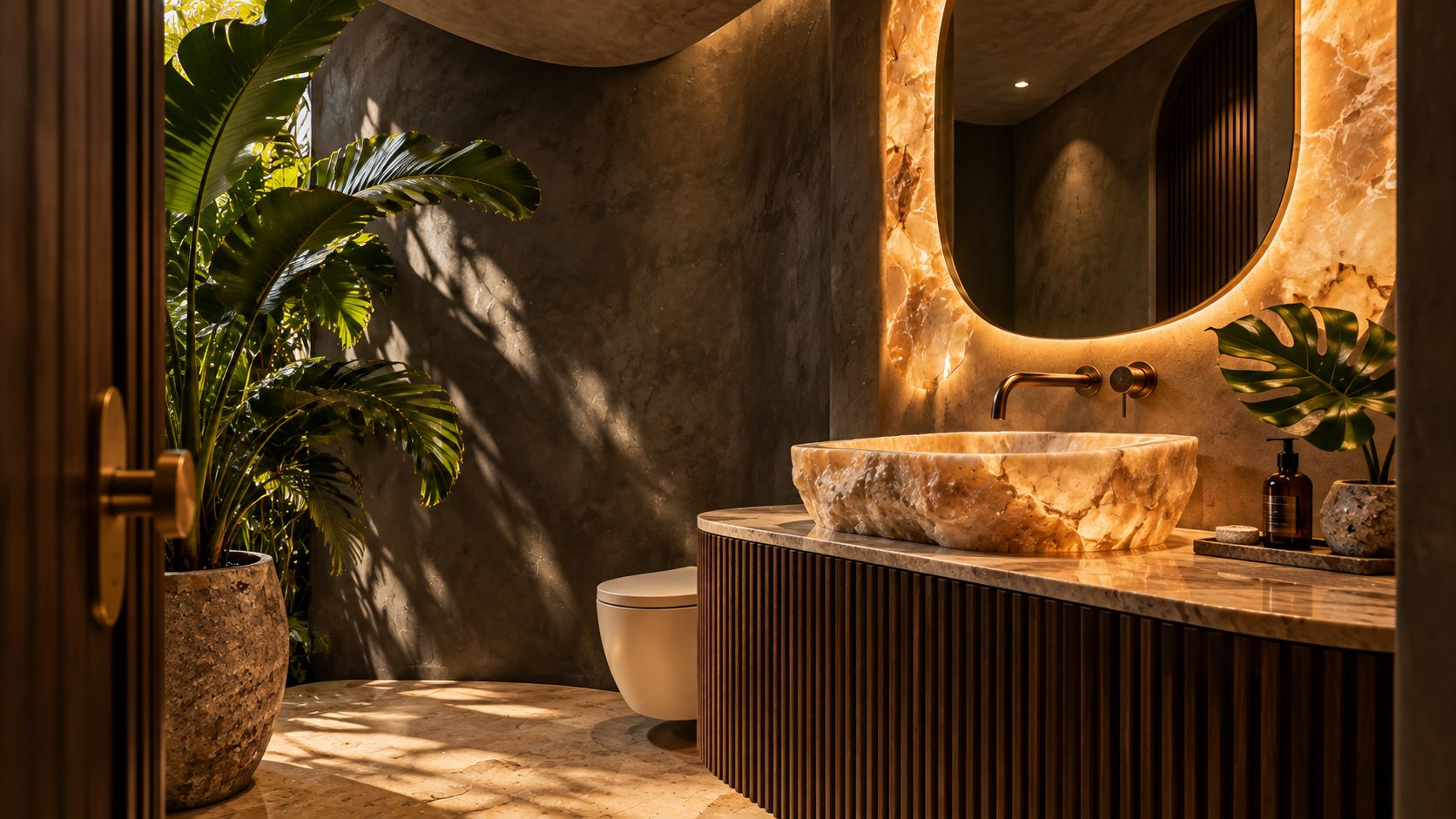
Backlit mirrors have a soft glow around or behind the glass, and they have become a popular choice for a sleek, modern look. Some are lit from the edges, and others from behind, creating a halo effect on the wall. They can look beautiful and they reduce the need for separate fixtures near the mirror.
Their lighting character is different from sconces. The glow is gentle and wraps the mirror, but it may not light your face as strongly as lights at the sides. Some mirrors include front lighting built into the glass, which is designed for grooming. Ask to see how a mirror performs in a room like yours and not only in a bright store.
Backlit mirrors need power at the right place, and the mirror's wiring has to be planned before the wall is finished. They also depend on a product that may need service over time, so ask about how it is maintained and what happens if a part fails. Our page on mirrors and medicine cabinets covers how these pieces are planned and installed.
If you love the look but want stronger task light, combine a glowing mirror with a pair of slim sconces or a ceiling fixture. The mirror then provides atmosphere and the other fixtures provide the working light. Layering this way gives you the style you want without sacrificing the practical side, and it lets you adjust the mood by dimming one layer while leaving another bright.
Mirror height and size
The ideal mirror lets people of different heights see themselves comfortably. If the bottom edge sits just above the backsplash or the faucet and the top edge reaches above the tallest person's head, most people can use it without stretching or stooping. A mirror that is hung too high is a common mistake.
Width is a design choice. A mirror that matches the width of the vanity looks balanced and gives the most reflection. A narrower mirror over each basin looks tailored and can work with sconces in between. A large oversized mirror can make the room feel bigger by doubling the view, which is useful in smaller bathrooms.
Consider who uses the room. A bathroom shared by adults and children, or by people of very different heights, needs a mirror that works for everyone. A mirror that tilts, or one placed lower, can help. Our page on accessibility explains how mirror placement can be part of a more usable bathroom.
Seating changes mirror needs, too. Someone who sits at the vanity needs a mirror that reaches down to seated eye level, and knee space beneath the counter. A tall mirror that starts low serves both seated and standing users. Mention these needs early, since the vanity height and the mirror height are decided together, and both affect the plumbing and the storage you can fit.
Light color and quality
The color of light changes how skin and surfaces look. Warm light feels cozy and flatters most skin tones. Cool light feels crisp and can make faces look pale. Mixing lights of different color temperatures in the same room can make surfaces look uneven, so choose bulbs that match across all fixtures.
Beyond color temperature, there is the quality of the light, its ability to show colors accurately. Light that shows true color is especially useful at the vanity, where you judge skin tone, makeup, and clothing. Product packaging often describes this, and a supplier can explain it. Our guide on bathroom lighting color temperature goes into the details.
Dimming is a gift in a bathroom. A bright setting for grooming and a soft one for the evening make the same room serve two moods. If you plan on dimmable lights, make sure the fixtures and controls are designed to work together, and ask the electrician to confirm. Our page on bathroom lighting controls explains the options.
Think about night use as well. A soft light that comes on low in the evening lets you move through the bathroom without a harsh blast of brightness. Some people add a gentle glow under the vanity or in the toilet area for this reason. These touches cost little thought at the planning stage and make a big difference at two in the morning.
Glare, reflections, and the finish of the mirror
Glare happens when a bright source reflects directly into your eyes. Bare bulbs facing the mirror, glossy surfaces next to the light, and very high output fixtures can all cause it. Shades, frosted glass, and diffusers soften the light and make it comfortable to look at.
The mirror itself can contribute. An antiqued or beveled mirror scatters light in a decorative way, which looks lovely but can reduce clarity for grooming. A plain flat mirror gives the clearest reflection. Think about whether the mirror is decorative or functional, and choose accordingly, perhaps with a separate small magnifying mirror for detail work.
Where the mirror faces matters as well. A mirror opposite a window can reflect bright daylight into your eyes, and a mirror opposite a shower door can fog. Place and size your mirror with its surroundings in mind, and test a large sample or a temporary cardboard cutout on the wall if you are unsure.
Also consider what else the mirror shows. A mirror that reflects the toilet or a cluttered shelf does not do the room any favors. Stand at the doorway and at the vanity and notice what appears in the glass. Sometimes shifting a mirror by a few inches, or choosing a slightly different size, replaces an awkward reflection with a view of a window, a plant, or a clean wall, and the whole room feels better for it.
Humid rooms and mirror care
Bathrooms are humid, and humidity is hard on mirrors and their frames. In our warm climate with salt in the air near the coast, the edges of a mirror and the metal of a frame can show wear sooner than they would in a dry room. Ask about edge sealing and frame finishes that suit a bathroom.
Ventilation protects mirrors. A fan that clears steam helps reduce fogging and the dampness that creeps behind the glass. If a mirror fogs for a long time after every shower, the fan may need attention. Our guide on ventilation and humidity in Florida bathrooms explains how to think about it.
Defogging features, such as a heated pad on the back of a mirror, are available on some products and can be handy in a busy household. Like any electrical feature, they need to be planned with the electrician, who knows what is allowed for wet rooms in your area. Ask your city building department what applies in your case.
Medicine cabinets and storage behind the glass
A mirror can also be a door. Recessed medicine cabinets hide everyday items behind a mirrored front and clear space on the counter. They are a smart choice in small bathrooms, and they can include built in lighting and outlets for electric grooming tools.
Because they sit inside the wall, they need framing and depth in the right place, which can interfere with plumbing or wiring. Decide on a medicine cabinet before the wall is built. Our guide on bathroom storage ideas covers other ways to add storage without crowding the room.
If you want a cabinet with lighting, plan the pairing carefully. Built in lights can be convenient, but they may not match the other lights in color or brightness. Make sure everything in the vanity zone looks like a family, not a collection of strangers.
Outlets near the vanity are part of the same plan. Hair dryers, shavers, and electric toothbrushes all need power, and a mirror cabinet with its own outlet keeps cords off the counter. Where outlets go, and what protection they need in a wet room, are electrical matters that follow local requirements. Ask your electrician and your city building department, and bring your list of devices so nothing is forgotten.
Putting the pairing together
Start with how you use the vanity. Do you shave, apply makeup, or style hair there? Do two people use it at the same time? Is the room small or large? Answers like these suggest a layout: sconces for detailed grooming, a long overhead fixture for tight spaces, a backlit mirror for a clean, modern look.
Then mock it up. Hold cardboard or paper where the mirror would hang, and tape paper circles where the lights might go. Stand in front and imagine your face lit from each position. A few minutes of this exercise saves months of regret.
If the bathroom is part of a larger project, bring the mirror and light plan into the same conversation as the vanity, the countertop, and the tile. Our overview of vanities and storage shows how these pieces are chosen together. Decisions made as a group look intentional, while decisions made one at a time tend to leave gaps that show up only after everything is installed.
This guide is general advice for homeowners. Electrical work must follow local requirements, and your electrician and city building department decide what is acceptable. Our guide on bathroom electrical planning explains the questions to bring to them.
Good to know
Common questions
Are lights beside the mirror better than above it?
Side lights usually give more even light on the face, which reduces shadows. Overhead lights work in tight spaces and suit simpler layouts, but they can cast shadows under the eyes and chin. Many rooms use a mix, so the face is lit from more than one direction.
How high should vanity lights be mounted?
Side lights generally sit around face height, so light lands on your features rather than above them. The right position depends on the people who use the vanity and the mirror size. Mark positions with tape and stand at the vanity before the electrician places wiring.
Do backlit mirrors light my face well enough?
Some do and some do not. A gentle glow around the glass looks lovely, but it may not light your face as strongly as side lights. Look for mirrors with front lighting designed for grooming, and ask to see one working in a room like yours.
How wide should a bathroom mirror be?
Matching the vanity width looks balanced and gives plenty of reflection. Individual mirrors over each basin look tailored and can leave room for lights in between. Think about who uses the room and whether side lights need to sit within the mirror's width.
What kind of bulbs suit a vanity?
Choose bulbs with a warm to neutral tone that show colors accurately, and use the same type across the room so surfaces look consistent. Dimmable options let you switch between bright grooming light and a soft evening mood. Ask your electrician to confirm compatibility.
Can I plan mirror and lights after the walls are finished?
It is much harder. Wiring, blocking, and any recessed cabinet depth are set inside the wall, so positions need to be decided early. Changing them later can mean opening finished walls. Settle the mirror and light plan before electrical work begins.
Your bathroom starts with a conversation